Sunday, May 13, 2012

JUST HOW GREAT IS TWO THIRDS OF HIS COMMISSION?


Following His Resurrection, and prior to His Ascension, Jesus gave these instructions to His disciples:

“And Jesus came and spake unto them, saying, ‘All power is given unto me in heaven and in earth.  Go ye therefore, and teach all nations, baptizing them in the name of the Father, and of the Son, and of the Holy Ghost:  teaching them to observe all things whatsoever I have commanded you: and, lo, I am with you alway, even unto the end of the world.’ Amen.” (Matt. 28:18-20).  NOTE:
1)     Because I have been given authority over both heaven and earth, I am to be your Lord.
2)     As your Lord, I command you to go teach ALL nations the Gospel.
3)     As your Lord, I command you to baptize ALL who believe the Gospel.
4)     As your Lord, I command you to teach ALL who believe the Gospel and are baptized, those same things I have taught you.
5)     As your Lord, I will never leave you.
Today, the Church has understood that Jesus is to be our authority.  The Church has understood that we are to teach the Gospel to every nation.  The Church knows that it is to baptize those who accept Jesus.  Apparently, the Church does not seem to grasp the command to teach believers the same things Jesus taught His disciples.  Apparently, what the Church has done is teach the Gospel and baptize, and then left the new born believers to “feed themselves.”  If you were to ask a hundred born again believers from anywhere around the world, “Whose responsibility is it that you learn all that Jesus taught His disciples,” you would get one hundred responses, “Mine.”  And, quite honestly, they would ultimately be correct.  After all, the Word does say that they have the Holy Spirit, and therefore, they have no need that any man should teach them (1 Jn. 2:27).  Right?

But what about the command to teach them ALL that Jesus taught His disciples (Matt. 28:20)?  What about the Lord’s thrice telling Peter to “feed My sheep” (Jn. 21:15-17)?  What about the fact that God provided Apostles, Prophets, Evangelists, and Pastor Teachers to fulfill His “Great Commission” (Eph. 4:11-16)?  What about Paul’s admonition to older women to teach the younger (Titus 2:3-4)?  What about the rebuke of older Christians for failing to teach others (Heb. 5:12)?  Mature Christians should treat those younger than themselves in the Lord, as a parent would his child (Eph. 6:4)!

Do you know how to identify young believers?
They are the ones who desire the sincere milk of the Word (1 Pet. 2:2)!

Saturday, May 12, 2012

WE MISS YOU MOM!


TRUSTING GOD WITH OUR PRECIOUS MOTHER
In tears we saw you sinking, and watched you pass away.
Our hearts were almost broken, we wanted you to stay.
But when we saw you sleeping, so peaceful, free from pain,
How could we wish you back with us, to suffer that again.
It broke our hearts to lose you, but you did not go alone,
For part of us went with you, the day God took you home.
                    If Roses grow in Heaven, Lord please pick a bunch for me,
                    Place them in my Mother's arms and tell her they're from me.
                   Tell her I love her and miss her, and when she turns to smile, 
                    Place a kiss upon her cheek and hold her for awhile.
                    Because remembering her is easy, I do it every day,
                    But there's an ache within my heart that will never go away.
Don't think of her as gone away, her journey's just begun
Life holds so many facets, this earth is only one
Just think of her as resting from the sorrows and the tears
In a place of warmth and comfort where there are no days and years
Think how she must be wishing that we could know, today
Now nothing but our sadness can really pass away
And think of her as living in the hearts of those she touched
For nothing loved is ever lost and she is loved so very much.

                                                                      Anonymous

WHY CHRISTIANS ARE HYPOCRITES


If I am a born again believer, why do I still sin?  Why do I have such a problem with sin while I am here on earth?  Why am I still troubled with impure thoughts?  Why do I sometimes fail to do what I know is right?  Why do I continue to battle with temptations?  Why do I often have a “bad attitude?”  In other words, why do I act like an unbeliever?  Believe it or not, it is because all genuine Christians on this side of heaven, have a “split personality!” 

The Bible describes saved individuals as having two competing natures.  Jeremiah 17:9, in describing every man, says, “The heart is deceitful above all things, and desperately wicked:  who can know it?”  “Desperately wicked” is from the Hebrew אָנַשׁ ('anash), which means “incurably sick.”  There is nothing anyone can do to “save” the dying man; he is doomed.  The disease is far worse than cancer, leprosy, or even AIDS – the number one killer of every man is SIN!  Apart from God’s intervention, every human being will die as the consequences of a single sin (Gen. 2:17; 1 Cor. 15:21-22).  Born again or not, we are all in the image and likeness of Adam, and we all sin, and we all die as the result (Gen. 5:3; Rom. 3:23; 1 Jn. 1:8-10). 

When we accepted Jesus Christ as our Lord and Savior, the Bible says we were saved (Jn. 1:11-12; 3:16; 14:6; Acts 16:31; Rom. 10:9-13; etc.).  However, “being saved” does not mean one is perfect.  The Apostle Paul wrote that God had begun a “good work in you,” and that He will complete it (Phil. 1:6).  He wrote that we should realize that the things which occur in our lives are designed to make us more like Christ (Rom. 8:28-29).  He pleaded with believers to stop being conformed to the ways of this world, and to be “transformed by the renewing of your mind” (Rom. 12:1-2). 

Yes, genuine Christians are “born again,” but their new birth with their new nature is now in a battle with their old nature (Rom. 7:14-25).  Notice Paul uses the present tense when describing his struggle between the two natures.  I am” (v. 14).  sin that dwelleth in me” (v. 17).  in medwelleth no good thing” (v. 18).  evil is present with me” (v. 21).  O wretched man that I am!” (v. 24).

When a person places their trust in Jesus, God is just in forgiving his sin; He justifies us (Jn. 3:1-8; Rom. 3:24, 28; 5:1, 9; 8:30; etc.).  From the moment of our new birth, God sanctifies us; that is, cleanse him for His own use (Rom. 15:16; 1 Cor. 6:11; 2 Thes. 2:13; Heb. 13:12; etc.).  There is one more “stage” in the process of making the believer back into the likeness of his Lord:  He will glorify us (Gen. 1:26-27; Rom. 8:17, 30; 1 Cor. 15:49; Phil 3:21; 2 Pet. 1:3-4; etc.).  The Apostle John put it this way:  “we shall be like Him” (1 Jn. 3:2)!  

If we shall be like Him, that means we are not like Him now.
It is no wonder the world sees us as hypocrites!

Friday, May 11, 2012

THE LIKENESS OF ADAM

On May ninth, I said I would continue on this topic if the Lord be willing.  He was not.  My precious great granddaughter of eight weeks required serious surgery on the tenth, and I was unable to continue at that time.  My hope is to do two posts today in order to catch up.  My thanks to all of you who prayed for our little Karalynn.  The doctors believe they have corrected the problem.  Please continue to pray for her recovery.  Thank you.

Following my last post, I met with my Pastor to try to better understand the Doctrine of Original Sin and the Doctrine of Accountability.  This is my current understanding of these two doctrines.  The Doctrine of Original Sin teaches that all human beings were corporately "in Adam" when he sinned, and the consequences of his sin were passed on to all mankind.  This concept is not unique in that Levi was said to be in Abraham when he payed tithes to Melchizedek (Heb. 7:9).  So, just as the blessing is inherited, so also is the curse.  In the case of the Doctrine of Original Sin, Adam's offspring have inherited the consequence of his sin:  death (Rom. 5:12), and also his desire to be equal to God, or to be his own God (Gen. 3:5).  That is why a child insists on having its own way; he has Adam's nature.

The Doctrine of the Age of Accountability, as I currently understand it, teaches that God is merciful in regard to young children who unknowingly defy God.  Deuteronomy 1:39 says, "Moreover your little ones, which ye said should be a prey, and your children, which in that day had no knowledge between good and evil, they shall go in thither, and unto them will I give it, and they shall possess it."  However, there comes a time in each child's life that he understands he is accountable to God, and when he chooses to defy Him, he is deemed guilty before God (Rom. 5:12).  

While some denominations of Christianity set a specific age at which a child is said to be accountable, it is clear from children accepting Christ and being born again at an earlier age, that the age of accountability varies.  Based upon John 16:8-9, it would appear that when the Holy Spirit convicts an individual of sin, righteousness, and judgment, should the person reject Jesus, he is declared to be "lost" because he does not believe in Jesus.  This would also apply to those who are mentally challenged.  

There may never be an age at which time someone who is of limited intelligence can comprehend the Gospel, but it is the Gospel which provides the good news that, just as in Adam all die, those who trust in Jesus' death, burial, and resurrection on their behalf (1 Cor. 15:1-4), are baptized by the Holy Spirit into Christ (Gal. 3:21; Eph. 4:5), and are passed from death to life (1 Cor. 15:22).  That is good news indeed.  If you have never accepted God's offer of forgiveness and the free gift of salvation through trusting in Jesus Christ, there is no better time than the present as the Scriptures say, this is the day of salvation (2 Cor. 6:2)!  

There is no time like the present to accept God's Present!     

Wednesday, May 9, 2012

THE LIKENESS OF GOD OR OF ADAM

I could be wrong.  I must be wrong.  The whole Church can not be wrong and a single individual (me) be right.  It is ludicrous to even think it.  And so, my study continues on the Doctrine of Original Sin.  I may have hit on something that will help straighten me out.

In Genesis 1:26-27, God created Adam in His own image and likeness.  But by Genesis 5:3, Seth was born in the image and likeness of Adam.  Does that mean Adam was no longer in the image of God?  No, for we find in Genesis 9:6, that God warns man not to kill, saying, "Whoso sheddeth man's blood, by man shall his blood be shed: for in the image of God made He man." That means Adam was still in God's image, because his offspring continue to be in God's image (Gen. 9:6).  Adam ceased to be in God's likeness.  His offspring, including you and me, according to these verses, are in the likeness of Adam, and not the likeness of God (Gen. 5:3; 9:6).

So how are we unlike God?  We are not righteous (Rom. 3:10); we don't think like God (Isa. 55:8-9); God is Spirit; man is carnal (Rom. 8:6-7); man had a beginning, but God is eternal (1 Tim. 1:17); etc.  As for our being in God's image, what does that mean?  Both God and man are a trinity:  God is Father, Son, and Holy Spirit (Matt. 28:19; 1 Tim. 3:16; Acts 5:1-4); man is body, soul, and spirit (1 Thes. 5:23).

Now we know that man dies as the result of Adam's sin.  Paul wrote, "For since by man came death, by man came also the resurrection of the dead.  For as in Adam all die, even so in Christ shall all be made alive" (1 Cor. 15:21-22).  Since Adam's death occurred the day he ate of the forbidden fruit (Gen. 3:5), and we know he did not die physically until hundreds of years later (Gen. 5:5), Adam must have died spiritually.  That is another way man is not in God's likeness; man is spiritually dead, while God is an eternal life-giving Spirit (1 Jn. 5:11, 13, 20).

Jesus told Nicodemus that he needed to be born again, to be born of the Spirit (Jn. 3:1-8).  Nicodemus obviously had been born physically, but he, like Adam, was spiritually dead.  Jesus referred to the physical birth as being of water, and spiritual birth being the work of the Holy Spirit.  John wrote, "Jesus answered, Verily, verily, I say unto thee, Except a man be born of water and of the Spirit, he cannot enter into the kingdom of God.  That which is born of the flesh is flesh; and that which is born of the Spirit is spirit" (Jn. 3:5-6).  Some have suggested the water refers to baptism, but that cannot be in that baptism is performed after one has been born again spiritually.

Because man is born spiritually dead (no longer in the likeness of God) as a result of the original sin committed by Adam, theologians have labeled it the Doctrine of Original Sin.  Fortunately for man, Jesus has provided man with a guaranteed resurrection from the dead (1 Cor. 15:22).  Unfortunately, not all will remain "raised" to life (Jn. 5:28-29).  Those who were not born again will be raised "unto the resurrection of damnation," also know as the "second death" (Rev. 2:1; 20:6, 14; 21:8).

To be continued, Lord willing!

Tuesday, May 8, 2012

ORIGINAL SIN OR AGE OF ACCOUNTABILITY

For the past few days, I have stated that I believe the Doctrine of Original Sin could not be supported by Scripture.  I said that Bible scholars misinterpret Psalm 51:5, and that Jewish scholars do not believe in the doctrine.  Perhaps one of the best arguments against it is the almost universal belief among Christians in the Doctrine of the Age of Accountability.  

Let me begin by stating there is no such age mentioned in the Bible.  Most believe that the "age" varies from child to child.  While one child may understand he must answer to God for his sin at the age of three, another child may become aware at the age of eight.  Mentally handicapped individuals may never become aware, and like newborns, would not be held accountable.


There are two kinds of sins, both requiring knowledge of God's will:  sins of commission, which involve breaking God's Law (1 Jn. 3:4), and sins of omission (Jam. 4:17).  In other words, for one to sin, one needs to be aware that he is answerable to God for purposely defying Him, and then to do so. 

As for the belief that a newborn is a sinner because he has inherited a sin nature from Adam, Ezekiel 18:20 would challenge that.  It says, "The soul that sinneth, it shall die. The son shall not bear the iniquity of the father, neither shall the father bear the iniquity of the son: the righteousness of the righteous shall be upon him, and the wickedness of the wicked shall be upon him."  If a newborn does not bear the iniquity of his own father, how can he bear the iniquity of Adam?  As I pointed out on May 6, we are "in Adam" because we sin (Rom. 5:12).

The consequences of Adam's sin (Gen. 3:17-19) clearly plague humanity to this day, but those consequences effect the physical world, and not the spiritual.  Let's say your father is an alcoholic, and he wrecks his car with you in it.  Your physical injuries are the result of his sin, but that does not make you an alcoholic, nor does it make you guilty of drunken driving.  However, when you are old enough to legally drive and old enough to legally drink, should you choose to do both, you are guilty.  Of course, in such a case, even if you were under age, say twelve, should you do those things, you are still guilty.  The key here is that the individual has knowledge of the law, and chooses to break it.  A two year old, having found his fathers alcohol, and left in a running car, would not be guilty if he pulls the gear shift into drive.   

 
The bible shouts loudly from its pages that we are all free-will agents, and each one of us will have to give an account for what we do -- not for the sins of others. We all suffer the physical consequences of both our own sins and the sins of others. However, we fall victims to the spiritual consequences of other people's sins only when we follow them into sin ourselves.

You can't have it both ways; 
either there is original sin, 
or there is an age at which one is accountable.

Monday, May 7, 2012

PSALM 51:5 DOES IT TEACH ORIGINAL SIN?: Part Two

2 Sam 10:2 -  “Then said David, I will shew kindness unto Hanun the son of Nahash, as his father shewed kindness unto me. And David sent to comfort him by the hand of his servants for his father. And David's servants came into the land of the children of Ammon.”  David's mother was most likely the second wife of Jesse, the first wife being the mother of David's half-brothers. Jesse’s first wife's standing before the 'righteousness of the law', (her not having been married to, or the concubine of, a heathen king, as was David’s mother), would have been superior to that of David's mother, and explains why David's half-brothers, Jesse's other sons, would have felt they were superior to David, and why he would be accused of being prideful, for thinking he was as good as them....

1 Sam 17:28-30 - (v. 28)  “And Eliab his eldest brother heard when he spake unto the men; and Eliab's anger was kindled against David, and he said, Why camest thou down hither? and with whom hast thou left those few sheep in the wilderness? I know thy pride, and the naughtiness of thine heart; for thou art come down that thou mightest see the battle.  (v. 29)  And David said, What have I now done? Is there not a cause?  (v. 30)  And he turned from him toward another, and spake after the same manner: and the people answered him again after the former manner.”  ...and why David was not considered, by his father Jesse, as `true' a son as his half-brother. Samuel had called Jesse and his sons, and thus expected `all' his sons, to the sacrifice (1 Sam 16:5,11). Jesse, having been told to bring `his sons' by a prophet of the Lord everyone feared (1 Sam 16:4), was confident he had obeyed the prophet, even knowing he did not bring David....

1 Sam 16:11 -  “And Samuel said unto Jesse, Are here all thy children? And he said, There remaineth yet the youngest, and, behold, he keepeth the sheep. And Samuel said unto Jesse, Send and fetch him: for we will not sit down till he come hither.”  ....which would be consistent with God's sometimes choosing that which men esteemed as worthless (the `least') to be the greatest: (Gideon- Jud 6:15; King Saul - 1 Sam 9:21; Jesus- Mt 2:6, Lk 9:48).  David's mother was apparently a Jewish woman, because `no Ammonite shall enter the congregation of the Lord to the 10th generation’ (Deu 23:3), and yet in Ps. 86:16 and Ps. 116:16, David refers to himself as "the son of thy handmaid", which would seem to testify to his mother's relationship with the Lord.  David's mother was, in the eyes of Jewish law, considered 'defiled' by her previous relationship to an Ammonite (Num. 25:1, 2; Deut. 7:3, 4; 1 kgs. 11:2-4, Ezra 9:2; Neh. 13:23, 25; 2 Co 6:14-17.

This is not to be accepted as truth - it is intended for consideration only.

PSALM 51:5 DOES IT TEACH ORIGINAL SIN?: Part One

This is from a perspective on Ps. 51:5 by William P. Murray, Jr.  (with permission).
Are men born sinners?  A commonly abused 'proof' text is Psalm 51:5.  Although I cannot claim the following as a result of my own scholarship or research, the information is a culmination from many sources over the years, and, I feel, the best explanation of this particular text that I have come across.

Psalm 51:5 - "Behold, I was shapen in iniquity, and in sin did my mother conceive me." (KJV).  This is a Hebrew poetic parallelism, with the second line of the verse saying the same thing as the first line in a slightly different way.  The first verb, of which David is the subject, is in the Pulal tense (as is "made" in # Job 15:7 ), which is an idiom used to refer to creation or origins, and is the 'passive' form of Polel ("formed": # Ps 90:2 Pro 26:10). TWOT, #623, 1:270.   The subject of this verse is NOT the state or constitution of David's nature as a sinner at, or before, his birth. The subject is, as the verse clearly states, the `circumstances' of his conception- the sexual union which produced him was an act of sin, and addresses the unrighteousness of his mother's act, not anything (such as a sin nature) inherent within himself. (The NIV's version of this verse is an INTERPRETATION, not a translation: "Surely I was sinful at birth, sinful from the time my mother conceived me.")

David had two half-sisters (Zeruiah, Abigail).....:1 CHR 2:13-16 - (v.13)  “And Jesse begat his firstborn Eliab, and Abinadab the second, and Shimma the third, (v. 14)  Nethaneel the fourth, Raddai the fifth, (v.15)  Ozem the sixth, David the seventh:  (v. 16)  Whose sisters were Zeruiah, and Abigail.  And the sons of Zeruiah; Abishai, and Joab, and Asahel, three.  (v. 17)  And Abigail bare Amasa: and the father of Amasa was Jether the Ishmeelite.”....and the father of David's half-sisters was not Jesse, but Nahash:  2 Sam 17:25  -  “And Absalom made Amasa captain of the host instead of Joab: which Amasa was a man's son, whose name was Ithra an Israelite, that went in to Abigail the daughter of Nahash, sister to Zeruiah Joab's mother.”

Nahash, the father of Zeruiah and Abigal, David's half-sisters, was an Ammonite king:  1 Sam 11:1 - “Then Nahash the Ammonite came up, and encamped against Jabeshgilead: and all the men of Jabesh said unto Nahash, Make a covenant with us, and we will serve thee.”  1 Sam 12:12  - “And when ye saw that Nahash the king of the children of Ammon came against you, ye said unto me, Nay; but a king shall reign over us: when the LORD your God was your king.”  David's father was Jesse, not Nahash. Zeruiah and Abigal were David's half-sisters through his mother's previous marriage to Nahash. This would also help explain why Nahash showed kindness to David, perhaps out of respect for David's Mother, Nahash’s former wife and the mother of two of Nahash's children.

TO BE CONTINUED

Sunday, May 6, 2012

ORIGINAL SIN OR ORIGINAL CHOICE?

First Corinthians 15:22 says, "For as in Adam all die, even so in Christ shall all be made alive."  Romans 5:18 says, "Therefore as by the offence of one judgment came upon all men to condemnation; even so by the righteousness of one the free gift came upon all men unto justification of life."  Based upon these verses, one could come to the conclusion that everyone is "in Adam," and "in Christ."  That is the logical conclusion, since all men die, even so, or likewise, all men shall be made alive. 

Obviously, that logic can not be true as it is not in harmony with the rest of the New Testament.  Clearly, the Word of God tells us that not all will be saved.  Jesus said, "Enter ye in at the strait gate: for wide is the gate, and broad is the way, that leadeth to destruction, and many there be which go in thereat:  because strait is the gate, and narrow is the way, which leadeth unto life, and few there be that find it" (Matt. 7:13-14).

I believe the most important question is, how does one get to be considered "in Adam" and "in Christ?"  Most if not all theologians believe one is "in Adam" simply by being born into the human race.  However, that presents a problem.  Our verses say "all!"  In the Romans passage, even the context fails to explain how "all" could be lost, and "all" will be saved.  Two verses use the word "many" in describing those in Adam and those in Christ (v. 15, 19).  Verse fifteen speaks of many dying, when we all know, death is universal (apart from Enoch, Elijah, and those caught up in the Rapture).  The same verse compares that with salvation being a gift unto many (the argument requires "many" here to also be universal, with the exception of Judas Iscariot, the Antichrist, and the False Prophet of Revelation).  Verse nineteen says, "For as by one man's disobedience many were made sinners, so by the obedience of one shall many be made righteous."  Here again, the structure of the argument requires that the "many" made sinners be the same as the "many" made righteous.  if by "many," Paul meant "all" when describing the sinners, then he must be saying "all" will be saved.

I believe the answer lies in how we get "in" Adam and "in" Christ.  The Word is clear that one is baptized (Spirit baptism - Gal. 3:27; Eph. 4:5) into Christ when he places faith in Him.  I would like to challenge the belief that man is born "in Adam," by suggesting we become "in Adam" when we act like Adam.  Just as one becomes born again in Christ by trusting in God, one becomes spiritually dead when he ceases to trust in God.  That is, when Adam sinned, he no longer believed God.  He chose to believe Satan and he died spiritually.  When we choose to trust in God's Son instead of the world, the flesh, and the devil, we become "in Christ."

That solves the "all" problem concerning "all" being saved.  It also solves the "many" problem in regards to the "many" in Adam.  Now all I have to figure out is Psalm 51:5!  That may take a while!

If it takes a choice to be saved, why does it not take a choice to be lost?         


Saturday, May 5, 2012

ORIGINAL SIN

A friend and brother, Gary Smith, in challenging  a criticism of God on Facebook, had this to say, "I'm of the mind that they (and we) are "born that way."  We are all born with a sin nature and that's what we do in the flesh: sin.  But did God make them (and us) that way?  Nope.  Humanity made itself this way." The writer had said that God would be unfair in judging homosexuals, based upon "the fact that they are created that way."

I agree with Gary, in that, man chooses to act in a sinful manner.  I do not agree in the doctrine of being born with a sin nature.  God made (and still makes) mankind pure and holy.  When man chooses to sin, he, like Adam, dies spiritually.  Since all have sinned (speaking of those who have chosen to do what they know is wrong, or failing to do what they know is right), then all become spiritually dead.  Unless the individual is born again (spiritually by trusting in the Lord Jesus), he will die in his sins.

Some say all mankind is born with a sin nature, and therefore that is the "way God made them."   I believe that when we are born, we are pure and holy.   It is when we choose to act like Adam that we become like him.  Just as our nature changes to be like his, our nature becomes like that of Jesus when we place our trust in Him.

The only place in the Bible where it says man is "born in sin," is in John 9:34, where the man, blind from birth, was accused of such by those who rejected his testimony of the Lord's healing.  How did we come to accept that as doctrine?  Do we really want to believe the thoughts of those who rejected Jesus?

Rom. 5:12 says " Wherefore, as by one man sin entered into the world, and death by sin; and so death passed upon all men, for that all have sinned."  Notice that it did not say all were born with a sin nature, but that all die like Adam because all sin like Adam.

1 Cor. 15:21-22 says "For since by man came death, by man came also the resurrection of the dead. For as in Adam all die, even so in Christ shall all be made alive."  Again, note that Paul did not say a man is born dead, but that just as when he commits to be like Christ (trusts in Him) and is born spiritually, when he commits sin, he becomes like Adam, and becomes spiritually dead.

My view is consistent with God being the just Creator of sinless newborn babes, and with the commonly accepted "doctrine of accountability."  The "sin nature" is acquired when one chooses to sin; the "Christ nature" is acquired when one chooses Christ!  I do not know of a single theologian who would state that an aborted infant, or for that matter, a child of six months, goes to hell when it dies.  The doctrine of "original sin" did not even appear until the second century when
Irenaeus, the Bishop of Lyon, suggested it in his arguments against the gnostics.  The doctrine is not found in Judaism.

When an individual chooses to sin, he chooses death;
When an individual repents and trust Jesus, he chooses life!


A SHEEP-LED CHURCH

My time as Pastor, much like my time as a Christian School Principal, could best be described as short and sweet (most of the time).  Because I knew I was where the Lord wanted me, and because He was using me in the lives of those He chose me to lead, I had great joy and peace.  However, my stint as Pastor ended abruptly, due to a disagreement over how our members were treating our custodian, of all things.  I have often tried to make a joke out of my two years, two months, two weeks, two days, and too long stint as Pastor.  But by the time I was informed my services were no longer needed, I was both hurt and relieved.

After teaching only one year at a Christian School, I was asked by the Pastor to be the Principal.  I told him I would accept on one condition; if he ever disagreed with how I disciplined a student, that he speak with me in private about it.  Everything was fine for a year and a half, until I suspended four boys for their involvement with pornographic materials at the school.  The next day, one of the boys was at school, and when I asked why, he told me to ask the Pastor.  I did, and I resigned.  My last official act was to call the other three boys and tell them their suspension was rescinded.  I figured that it was unfair to "pardon" a boy whose parents were members of the church, and not the others.  The Pastor was gracious enough to keep me on for the next seven years as a teacher.  For that, I am grateful.

Christian leadership requires a "thick skin," a willingness to do without the "finer things in life," and most of all, the knowledge you are exactly where God wants you.  In Seminary, the majority of the students were preparing for a career, more so, than for the ministry.  In one class of about a hundred students, the professor was discussing how much a Pastor should charge for doing weddings and funerals.  When I asked why one would charge for doing what he was paid to do as Pastor, I was literally booed.  I figured that if one was being paid to serve as Pastor, and weddings and funerals were the normal duties of a Pastor, then his salary was payment for those duties.  I still feel that way.

Today, Christian leaders are "employees" of churches rather than shepherds of the flock.  Oh, I know your Pastor would never admit that, but it is true.  And God help him if he takes a public stand against cohabitation, divorce, or teen pregnancy; there are too many church members that might quit coming, and the collections might drop, and well, you know the rest.  The shepherd is fired by the sheep.  

Today, the United States, generally speaking, calls itself a "Christian nation."  That is ironic in that, with all of the advantages Americans have, we are number one in producing prisoners, pornography, teen pregnancy, reported crimes, mental disorders, drug use, divorce, and who knows what else.  The Church is supposed to be the moral anchor of a nation, but if the leaders are "muzzled" by their own congregations, is it any wonder that our country is in such a decadent condition?

Like the prophets of Israel before them, 
Pastors are an endangered "species!"  

Friday, May 4, 2012

JESUS IS OUR PASSOVER LAMB

The Jewish Passover consisted of selecting a lamb without blemish on the tenth day of the first month (Ex. 12:3), and keeping it until the afternoon of the fourteenth day, killing it, and preparing it to be eaten after sunset, which was the beginning of the fifteenth day, the first day of the seven-day Feast of Unleavened Bread (Ex. 12:6-10; Lev. 23:5-8).  Pilgrims to Jerusalem would travel there in time to find accommodations, select the lamb, and wait for the Passover.  Each evening, from the tenth until the thirteenth, they ate a normal supper, but on the fourteenth, they ate the Passover meal.

Nearly every preacher I have heard speak on the Passover traditions of the Jews, has said the Last Supper, celebrated by Jesus and His disciples, was the Passover meal.  They go to great length to say that the cup and the bread were a normal part of the Passover.  However, it should be obvious that what the Lord did with the bread and the cup was different from what had ever been done before, in that He identified with them as being His body and His blood (Lk. 22:19-20).  While the Synoptic Gospels seem to say Jesus was calling the meal they had eaten the Passover, John's Gospel clearly shows it was not.  Here is what John wrote concerning the meal: 

*  "Now before the feast of the Passover..." (Jn. 13:1)

*  "For some of them thought, because Judas had the bag, that Jesus had said unto him, Buy those things that we have need of against the feast..." (Jn. 13:29)

*  "Then led they Jesus from Caiaphas unto the hall of judgment: and it was early; and they themselves went not into the judgment hall, lest they should be defiled; but that they might eat the Passover" (Jn. 18:28).

*  "And it was the preparation of the Passover, and about the sixth hour: and he saith unto the Jews, Behold your King!" (Jn. 19:14).

*  "The Jews therefore, because it was the preparation, that the bodies should not remain upon the cross on the sabbath day, (for that sabbath day was an high day), besought Pilate that their legs might be broken, and that they might be taken away" (Jn. 19:31).

*  "There laid they Jesus therefore because of the Jews' preparation day; for the sepulchre was nigh at hand" (Jn. 19:42).

When we compare all that the Word of God has to say about the meal, 
we discover that Christ didn't eat the Passover; 
He WAS the Passover (1 Cor. 5:7)!


Thursday, May 3, 2012

THE GENEALOGIES OF JESUS

There are several differences between the genealogies of Jesus in Matthew and in Luke. Unbelievers use these differences to support their rejection of God's Word, but born again believers, knowing the Word of God is perfect (2 Tim. 3:16-17), understand that Matthew's genealogy is that of Joseph, and Luke's is Mary's.  Just as "beauty is in the eye of the beholder," Truth is recognized by those who are born again (1 Jn. 5:20).

Matthew 1:1-17 begins with Abraham and ends with "And Jacob begat Joseph the husband of Mary, of whom was born Jesus, who is called Christ.  Notice that it does not say Joseph begat Jesus; it says that He was born of Mary.  Jesus was "begat," but not of Joseph; He was the only begotten Son of God, Himself (Jn. 3:16).  The reason Matthew began his genealogy with Abraham is because his Gospel was written to verify that Jesus was Israel's long-awaited Messiah, their King, very God manifest in the flesh (Matt. 1:1; 14:33; 16:16; 27:37; 1 Tim. 3:16).

Luke 3:23-38 is not only in reverse order to Matthew's, it presents Jesus in His humanity, being both the Son of Adam, and the Son of God (v. 38).  To be certain that no one believed Jesus was the Son of Joseph, Luke's genealogy begins with "And Jesus Himself began to be about thirty years of age, being (as was supposed) the son of Joseph" (v. 23).  In one of the strangest prophecies of the Bible, God said that Eve's offspring would be the One who would eventually crush Satan:  "And I will put enmity between thee and the woman, and between thy seed and her seed; (He) shall bruise thy head, and thou shalt bruise His heel (Gen. 3:15).  Mary did not become pregnant by Joseph's seed, but "her seed."

Some have pointed out that there is an error in Matthew's genealogy.  Matthew wrote, "So all the generations from Abraham to David are fourteen generations; and from David until the carrying away into Babylon are fourteen generations; and from the carrying away into Babylon unto Christ are fourteen generations" (v. 17).  When you count the names listed, there are only forty-one individuals, when three times fourteen is forty-two.  But notice, Jechonias was listed twice, before the carrying away of Israel (v. 11), and after their "carrying away" (v. 12).  Why Matthew saw fit to do this, I have no clue.  It really is a moot point in that it is obvious that every generation in the genealogy of Jesus was not included.  Jesus was the seventy-seventh generation from Adam (see www.ldolphin.org/2adams.html).

Another amazing difference between the two genealogies is that one mentions women, and the other one doesn't.  You would think that Matthew, being written to show Jesus was the Jewish Messiah, would be the one to avoid listing women, since to the Jews, women played no role in their heritage of a man.  But believe it or not, it is Matthew that mentions Thamar (v. 3 Tamar), Rachab (v. 5 Rahab), Bathsheba (v. 6 "the wife of Urias"), and Mary (v. 16).  Mary is not mentioned by name in Luke's genealogy, and yet it is the genealogy of Jesus through the lineage of Mary!

If the Gospels were fiction, wouldn't the two genealogies be the same? 
     

Wednesday, May 2, 2012

PROVERBS 16:18

When a person becomes a born again believer by faith in Jesus Christ, he genuinely wants to please God.  The problem is, the success of living on a "spiritual mountain top" has a tendency to be very dangerous to the believer.  It is on those "mountain tops" that we tend to forget how we got there; we forget we are there because the Holy Spirit guided us.  Feeling we "have arrived," pride sets in, and before you know it, we end up in the "valley of despair."  Because of the great joy one experiences when living in the will of God, we often get complacent and let our guard down.  We begin walking "with our heads in the clouds," and before we know it, we have stepped off the ledge blinded by the sin of pride.  We have become more like Satan and less like Christ, who humbled Himself for us (Phil. 2:5-8).      

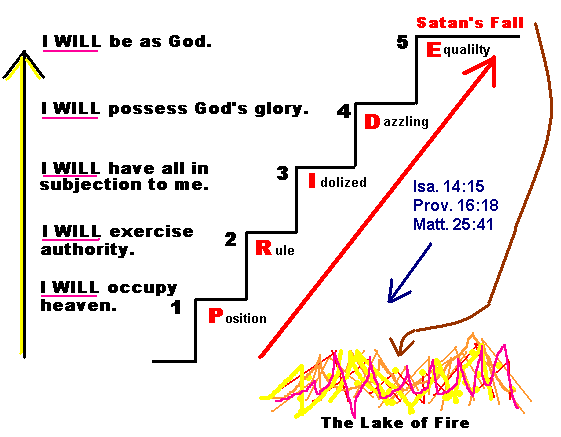
Satan's fall was due to his pride.  He hadn't killed anyone.  He hadn't tempted anyone.  He hadn't lied to anyone (except perhaps to himself).  He simply rebelled when he recognize that he was a creation and not the Creator!  He could not stand the fact that there was anyone greater than he.

Pastor George F. Parsons created this helpful diagram to show Lucifer’s five haughty "I WILLS":

As believers, we tend to think more highly of ourselves than we ought (Rom. 12:3).  As James put it, we are "...like unto a man beholding his natural face in a glass:  for he beholdeth himself, and goeth his way, and straightway forgetteth what manner of man he was" (Jam. 1:23-24).

So the next time you are "fessed up" (have your sins confessed - 1 Jn. 1:9), and you are walking in the Spirit and not in the flesh (Rom. 8:1-4), remember, the "mountain" you are on has steep cliffs.

The cure for pride is to compare yourself to Jesus!

Tuesday, May 1, 2012

THE FALSE PROPHET'S "CHIP"

The Second Beast of Revelation is often called the False Prophet because his main objective will be to get all of mankind to worship the First Beast, best known as the Antichrist (Rev. 13:1-18).  He will have the power to work miracles that will deceive most of humanity (Rev. 13:13-14).  In addition, he will be able to build a robot-like "image" of the Antichrist, and he will attempt to force everyone to worship the image or suffer the consequences (Rev. 13:14-15).  Those who comply will receive "a mark" on their right hand or forehead as proof of their allegiance to the Antichrist (Rev. 13:16-18).  The "mark" will consist of one of the following:  a mark, the name of the Beast, or "the number of his name."  We are told that the number is "Six hundred threescore and six" (Rev. 13:18).

The False Prophet, like the Antichrist, is not recognized by the Jews until the Antichrist commits the Abomination of Desolation at the mid-point of the seven-year Tribulation (Dan. 9:27; Matt. 24:15; Rev. 13:1-10).  That is because, until the Antichrist declares himself to be God, the False Prophet's "ministry" to force mankind to worship him would be premature.  

His ultimate goal, the same goal as the Satanic trinity, is described as follows:  "And I saw three unclean spirits like frogs come out of the mouth of the dragon (Satan, who would be worshiped as God), and out of the mouth of the beast (the Antichrist, who would be worshiped as the Christ), and out of the mouth of the false prophet (the Second Beast, whose actions betray his desire to serve in the same capacity as the Holy Spirit).  For they are the spirits of devils, working miracles, which go forth unto the kings of the earth and of the whole world, to gather them to the battle of that great day of God Almighty" (Rev. 16:13-14).  His end is mentioned later as he and the Antichrist are cast into the Lake of Fire (Rev. 19:20; 20:10).

There has been much speculation as to what the "mark" is.  The Apostle John was writing in Greek, and like Hebrew, Greek numbers are written using the alphabet.  For example, 666 is represented as χξϛʹ (600 + 60 + 6) in Greek manuscripts.  Some theologians have speculated that the Antichrist's identity can be determined by adding up the numbers of the letters spelling his name.  Others suggest that his names (first, middle, and last) will have six letters each.

Since his identity will not be revealed until the Antichrist's is revealed, for us to waste our time debating it seems vain and useless.  And as for the "mark" itself, we are not told what it is.  Many "experts" have suggested it will be a bar-code for scanning, or some other computer-readable matrix such as the relatively new QR codes.  Others have suggested the "mark" is not a mark at all, but that it is a computer chip.  Today, scientists have created a microchip so small that every single piece of data about you can be stored in a chip the size of a small grain of rice.    

As a result, many born again believers have opposed any governmental attempt at having everyone identifiable by an imbedded computer chip.  I am not sure I understand the resistance.  Born again believers will not be present on earth when the False Prophet is revealed with his diabolical scheme; we will have been removed by the Rapture at least three and a half years earlier (Jn. 14:6; 1 Cor. 15:50-58; 1 Thes. 4:13-18; 5:9).  And, since the "mark" is associated with man's willingness to worship the "Image of the Beast," bar codes, computer chips, etc. of today should not be feared as the sign one has rejected Jesus Christ (Rev. 13:16-17; 14:9-11; 15:2; 16:2; 19:20; 20:4).

The best way to be sure you are not worshiping the Antichrist 
is to be sure you are worshiping the Jesus Christ!


Monday, April 30, 2012

JOSEPH: A TYPE OF JESUS

Clarence Larkin, in his book, Dispensational Truth, wrote concerning Bible typology:  "The New is in the Old contained; the Old is by the New explained."  He was referring to the Old and New Testaments.  Larkin continued, "You cannot understand Leviticus without Hebrews, or Daniel without Revelation, or the Passover, or Isaiah 53 without the Gospel account of the Crucifixion."  In other words, the Old foretells what to expect, and the New gives us an explanation of what happened in the past.  Larkin gave for an illustration,  the "Brazen Serpent" (Num. 21:6-9) and the "Cross,"  of which Jesus spoke in John 3:14-15 

 A "type" is an example, a "shadow," a picture of what will occur in the future.  The Apostle Paul put it this way:  "Now all these things happened unto them for ensamples (τύπος - examples): and they are written for our admonition (νουθεσία - warning), upon whom the ends of the world (αἰών - age; in this case, the Church Age) are come" (1 Cor. 10:11).

Of all the Old Testament "types," Joseph is, by far, the most typical of Jesus.  Larkin mentioned these:

* Joseph was "beloved" of his father; so was Jesus.

* Joseph was God's gift to his brethren; so was Jesus.

* Joseph's brethren rejected him; so did Jesus'.

* Joseph was falsely accused; so was Jesus.

* Joseph was temporarily entombed in a prison; Jesus was temporarily entombed in the grave.

* Joseph was "resurrected" from the prison; Jesus is "the Resurrection."

* Joseph provided bread for the people; Jesus is "the Bread of Life."

* Joseph was married to a Gentile bride; Jesus' bride will be of the Gentiles.

* Joseph knew his brethren on their first visit; Jesus knew His brethren His First Coming.

* Joseph's brethren did not recognize him; Jesus' brethren did not recognize Him.

* Joseph's brethren recognized him on their second visit; Jesus' brethren will recognize Him at His Second Coming.

* Joseph made his brethren citizens of his kingdom; Jesus makes us citizens of His Kingdom.

We read the Old to know what to expect; 
We read the New to learn what God expects of us.


Sunday, April 29, 2012

GENUINE LOVE MOTIVATES SHARING

Read a really good book lately?  Seen an Academy Award worthy movie?  Discovered an inexpensive restaurant with "out of this world" food?  Know of an outstanding doctor or dentist?  If so, what do you always do?  You tell somebody!  In fact, many times, you cannot wait to see someone, so you call or e-mail them!  You, by nature, love to share with others, right?

One of the most important texts found in the Old Testament, at least to the Jews, is found in Deuteronomy 6:1-9.  It says:

"Now these are the commandments, the statutes, and the judgments, which the LORD your God commanded to teach you, that ye might do them in the land whither ye go to possess it:  that thou mightest fear the LORD thy God, to keep all His statutes and His commandments, which I command thee, thou, and thy son, and thy son's son, all the days of thy life; and that thy days may be prolonged.  Hear therefore, O Israel, and observe to do it; that it may be well with thee, and that ye may increase mightily, as the LORD God of thy fathers hath promised thee, in the land that floweth with milk and honey.  Hear, O Israel: The LORD our God is one LORD:  and thou shalt love the LORD thy God with all thine heart, and with all thy soul, and with all thy might.  And these words, which I command thee this day, shall be in thine heart:  and thou shalt teach them diligently unto thy children, and shalt talk of them when thou sittest in thine house, and when thou walkest by the way, and when thou liest down, and when thou risest up.  And thou shalt bind them for a sign upon thine hand, and they shall be as frontlets between thine eyes.  And thou shalt write them upon the posts of thy house, and on thy gates."

God, motivated by love for His children, wants us to know that focusing upon His Word, believing it, and doing it, is the basis for living a life that is not only pleasing to God, but which is the true source of one's own joy (v. 1-5).  And because He wants us to love our children as He loves His, He tells us to give them their proper place in our hearts (v. 6), and share them with our children, our grandchildren (v. 7), and with everyone we meet or who comes to our home (v. 8-9)!

When we look at those who met Jesus in the New Testament, often, the first thing they did was to go tell somebody.  When Andrew met Jesus, he immediately went to tell his brother Peter (Jn. 1:40-41).  When Philip recognized Jesus as the Messiah of Israel, he immediately went and told Nathanael (Jn. 1:43-46).  And when the Samaritan woman met Jesus at the well, she left her water pot and ran to tell those living in her city (Jn. 4:28-30).

When as a twenty-eight year old atheist, I came to trust in Jesus Christ as my Lord and Savior, I immediately began telling my wife, my children, my co-workers, and I called my dad.  Not only was I filled with great joy over discovering Jesus, I wanted everyone else to come to know Him too!  Today, over forty years later, I am writing this blog to tell anyone who will read it, Jesus died for me because He loved me; God raised Him from the dead because He loved me; and the Holy Spirit convinced me, sealed me, and guides me (when I will let Him).  Jesus is everything to me, and more than anything, I want you to experience the joy of knowing Him and of serving Him, and to have the confidence that when you die, you will live eternally with Him!

 Why?  Because I love you!  

TEN WAYS TO LOVE


LISTEN WITHOUT INTERRUPTING
(JAMES 1:19)

SPEAK WITHOUT ACCUSING
(PROVERBS 30:10)

GIVE WITHOUT SPARING
(PROVERBS 21:26)

PRAY WITHOUT CEASING
(1 THESSALONIANS 5:17)

ANSWER WITHOUT ARGUING
(PROVERBS 15:1)

ENJOY WITHOUT COMPLAINT
(1 TIMOTHY 6:17)

TRUST WITHOUT RESERVATION
(PROVERBS 3:5)

FORGIVE WITHOUT PUNISHING
(COLOSSIANS 3:13)

PROMISE WITHOUT FAILING
(ECCLESIASTES 5:4)

LOVE WITHOUT EXPECTING
(EPHESIANS 2:8-9)

Friday, April 27, 2012

DO THESE WORDS DESCRIBE YOU?

According to the Pew Forum's U.S. Religious Landscape Survey, which drew primarily on a nationwide survey conducted from May 8 to Aug. 13, 2007, 78.4% of Americans declare themselves to be Christians.  Of those, 51.3% state they are Roman Catholics, and 23.9% report themselves to be Protestants.  Based upon an estimated 300,000,000 population, that would mean there are 235,200,000 Christians living in the U.S., with 153,900,000 being Catholics, and 71,700,000 being Protestants. 

Based upon the morality of Americans as reported in the news media, do those numbers sound right to you?  I don't know about you, but I am surprised at the number of people who claim to be Christians, not only because of the moral decay in society as a whole, but especially when I stop and think about the immorality which goes unchallenged by churches today.  While professing Christians seem to be ignorant of how a believer should behave, those watching us appear to know how a Christian should behave.  It is no wonder that Christians are accused of being hypocrites.

Why do you think there is such disparity in how believers are supposed to behave, and how the professing church actually lives?  I believe it is because the Church has focused on salvation being by grace, being a free gift apart from merit or works, and as a result, it has failed to preach repentance and discipleship.  Repentance is nothing more than realizing one is headed in the wrong direction, and turning around to follow the One who leads us into a right relationship with God.  Discipleship is realizing there is One who not only knows how to be in relationship with God, but being willing to submit to His instruction.

I believe that a student of the Bible can discover the priority God places on things by how often He speaks of them in His Word.  On March 24th of this year, I wrote an article which stated that in the New Testament, Jesus is called "Lord" over 700 times, 200 of which are in the Gospels, and He is called "Savior" a total of only twenty-four times.  My point was that we are to submit to the Lordship of the One who saved us.  The numbers are very clear as to how God wants us to relate to Jesus:  He is Lord!

Today, I noticed that the word "follow" appears an average of twenty-two times, and the word "disciple" appears an average of over fifty-six times in the Gospels.  To me, that would indicate God wants His children to follow the example and commands of His Son.  It means that He expects us to be disciplined (trained as a disciple, a follower) in our manner of life.  Perhaps we need to emphasize all of Luke 24:47 and not just the fact that Jesus "remitted" our sins.

Do the words "disciple" and "follower" describe you?  I certainly hope so!  

Thursday, April 26, 2012

STEPHEN'S DEFENSE

Stephen, one of the seven deacons appointed by the Apostles (Acts 6:1-7), was falsely accused of "speaking blasphemous words against Moses and against God" (Acts 6:8 - 7:1).  I find it interesting that they accused him of rejecting Moses, and then, oh yeah, by the way, he did it to God too.  Stephen, when asked by the high priest if the charges against him were true, responded in one of the longest sermons in the Bible (Acts 7:2-53).

Stephen was polite and respectful toward the religions leaders (Acts 7:2), and then gave his "Reader's Digest Version" of the the history of the Jews.  He began with the call of Abraham and the promise his seed would possess the land (Acts 7:2-5).  Stephen reminded them of those things which transpired to cause the children of Israel to be in bondage to Egypt for 400 years (Acts 7:5-19).  He recounted how God used Moses to free Israel from Egypt, to give them God's Law, and to lead them in the wilderness for forty years (Acts 7:20-45).  He rehearsed how God allowed Israel to have an earthly king, and how Solomon was permitted to built the Temple in Jerusalem, a "dwelling place for God," even though the Creator of the Universe had all of heaven as His habitation (Acts 7:46-50).

Every thing was going fine until he called them "stiffnecked and uncircumcised in heart and ears," and that they did "always resist the Holy Ghost; as your fathers did, so do ye" (Acts 7:51).  Then he accused them of killing the "Just One," a name everyone knew that could only apply to the "Anointed One," Israel's Messiah, also known as the Christ (Isa. 61:1; Matt. 16:16; Jn. 1:41; 4:25).  He must have "struck a nerve," because they surrounded him and "gnashed on him with their teeth" (Acts 7:54).  This was a Jewish colloquialism for they began "to chew him out."

As they were preparing to stone Stephen, the Lord allowed him to see God's throne room, with Jesus standing at the right hand of the Father (Acts 7:55-56).  My pastor asked the question last night at Bible study:  "Jesus is always described as being seated at the right hand of the Father; why do you suppose Stephen saw Him standing?"  My first thought was, if He was anything like me, He was about to come down and "smite" a few guys.  Fortunately, He is not like me!  My pastor asked a second question:  "What do you do when someone enters the room?"  The answer is obvious; you stand out of respect!  Jesus was prepared to welcome Stephen home!  I do not know if He does that with every born again believer, but based upon Stephen's prayer for the forgiveness of his murderers, may have been the answer.  I am sure Jesus was not the only One to celebrate his "graduation" (Ps. 116:15)!

Stephen's defense was not aimed at winning his accusers to the Lord, as he did not present the Gospel (1 Cor. 15:1-4) which is the "power of God unto salvation" (Rom. 1:16).  Peter, being filled with the Holy Spirit, preached a salvation message to the Jewish leaders in Acts 2:14-36, but here, Stephen also being filled with the Holy Spirit, was not led to speak of Christ's Resurrection.  The Holy Spirit knew the outcome, and did not have Stephen "cast his pearls before the swine" (Matt. 7:6).  Ironic isn't it?  The self-righteous Jewish leaders, men who would have nothing to do with pork, actually qualified as "swine!"

The moral of the story:  
There is a time for preaching, and there is a time for silence.  
The only One who knows which is which is the Holy Spirit.